
How to Choose an Epoxy Sealant for a Concrete Garage Floor
For a garage floor that sees oil spills and daily vehicle traffic, start with clean, dry concrete. Remove oil and any loose coating, then have the surface checked for moisture and prepared so the new finish can bond. If you want a durable, easy-to-clean finish, choose an epoxy coating with a polyaspartic topcoat rather than picking an epoxy sealant for a concrete garage floor based on price alone.
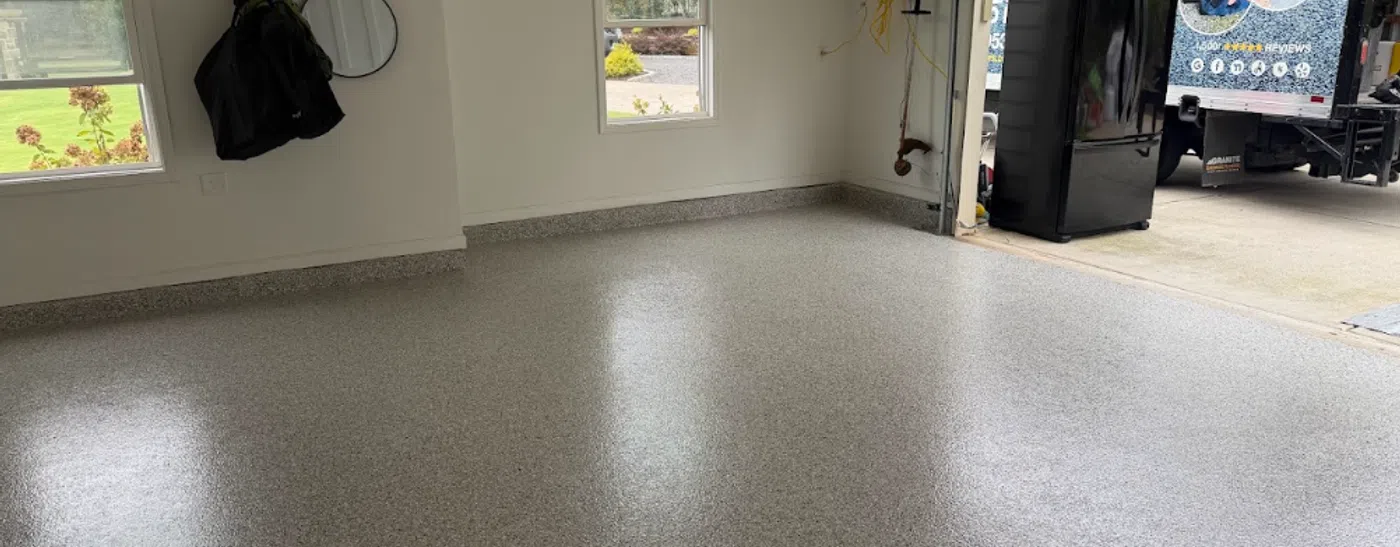
A sound bond matters as much as the product. That is especially true on smooth, power-troweled concrete or a floor where an old coating has peeled. We're Granite Garage Floors, and we install stone-look epoxy garage floors in Atlanta using a dedicated two-day installation process to ensure maximum adhesion and long-term durability.

Introduction to Epoxy Floor Protection and Durability
Bare concrete looks solid and unyielding, but under a microscope, it behaves like a giant, rigid sponge. Concrete contains millions of microscopic capillaries and pores formed as water evaporates during the curing process. Without proper protection, this natural porosity creates endless maintenance headaches.
Vehicular traffic subjects an unprotected slab to relentless mechanical wear, abrasive friction, and thermal shock. Hot tires freshly driven off scorching asphalt create a phenomenon known as hot tire pickup. As the tires cool, they contract, grabbing the concrete surface or weak surface films and tearing them away.
Furthermore, porous slabs suffer constant chemical degradation. Motor oils, brake fluids, transmission fluids, and de-icing road salts seep directly into the concrete matrix, causing deep discoloration and internal micro-fracturing. As moisture moves upward through the slab, it carries free lime and mineral salts to the surface, creating an annoying, chalky residue known as concrete dusting.
To solve these vulnerabilities permanently, an industrial-grade epoxy system acts as an impenetrable moisture barrier and armor shield. Epoxy bonds directly into the open pores of the concrete, transforming a weak, dusty floor into a durable, showroom-quality surface.

Why an Epoxy System Delivers Durable Garage Floor Protection
Homeowners looking for a lasting garage floor finish need a system built for daily vehicle traffic, oil spills, abrasion, and changing temperatures. Granite Garage Floors uses an industrial-grade epoxy basecoat with a polyaspartic topcoat to create a durable, easy-to-clean surface rather than relying on a thin surface treatment.
Epoxy System Layer |
Primary Function |
Garage Floor Benefit |
100% solids epoxy basecoat |
Bonds into mechanically prepared concrete |
Creates a strong foundation for long-term adhesion |
Decorative color flake matrix |
Builds thickness and visual depth |
Delivers a granite-, quartz-, or stone-look finish |
Polyaspartic topcoat |
Protects the finished surface |
Adds UV stability and resistance to automotive fluids, abrasion, and hot tire pickup |
How Epoxy Coatings Protect Concrete Garage Floors
Epoxy bonds directly into the open pores of mechanically prepared concrete, creating a continuous protective layer across the slab. That bond helps protect the surface from the oils, brake fluids, transmission fluids, de-icing road salts, and daily wear that can stain or degrade bare concrete.
A professionally installed epoxy system also helps control concrete dusting. By covering the prepared slab with a durable epoxy basecoat, the finished floor is easier to clean and better suited to the demands of an active garage.
Why Professional Epoxy Installation Matters
Long-term performance depends on the condition of the concrete before the epoxy is applied. Oil contamination, loose material, moisture concerns, and weak surface layers must be addressed so the epoxy basecoat can form a dependable mechanical bond.
Granite Garage Floors uses a dedicated two-day installation process that includes mechanical diamond grinding, crack repair, and controlled curing. This preparation gives the epoxy system the sound foundation it needs to support daily vehicle use and retain its finished appearance over time.
Epoxy and polyaspartic work together in the completed system. The epoxy basecoat provides the primary bond to the concrete, while the polyaspartic topcoat protects the decorative floor surface from UV exposure, automotive fluids, abrasion, and hot tire pickup.
Professional Preparation for Applying an Epoxy Sealant System on Concrete Garage Floors
The secret to a lifetime floor coating lies in our comprehensive two-day installation process and the rigorous preparation of the concrete slab. Unlike rushed shortcuts that compromise bonding, our two-day method gives the epoxy basecoat the necessary time to penetrate deep into the concrete and achieve full chemical curing. Simply mopping a cleaner over the surface is never enough for high-performance coatings.
Every concrete slab must undergo thorough mechanical diamond grinding. Heavy rotary planetary grinding machines equipped with diamond-embedded segments level the concrete, remove surface contaminants, open closed pores, and eliminate weak surface laitance. This grinding process creates an ideal Concrete Surface Profile (CSP 2 to CSP 3), leaving a texture similar to 80-grit sandpaper that gives the epoxy basecoat deep mechanical anchor points.

Our installation teams also test the concrete for moisture vapor emissions and evaluate power-troweled slabs. Power-troweling creates an extremely dense, slick surface crust that prevents liquid sealers from soaking in. Diamond grinding strips this slick skin away, ensuring the epoxy sinks deep into the concrete core.
Repairing Cracks and Control Joints Before Epoxy Application
Before applying the epoxy basecoat, every imperfection in the floor must be addressed. Unrepaired hairline cracks and spalled joints will quickly telegraph through any finish coating.
- Crack routing & cleaning: Technicians chase existing cracks using diamond crack-chaser blades, vacuuming out fractured concrete and fine debris.
- Structural joint patching: Deep cracks are filled with high-strength structural epoxy. For expansion joints that require movement accommodation, the installation team evaluates the joint before applying the floor system.
- Surface leveling: Once cured, all patched areas are ground flush with the surrounding concrete to ensure a seamless foundation for the epoxy.
Environmental Conditions, Temperature, and Epoxy Adhesion
Epoxy chemistry relies on controlled curing kinetics. Applying an epoxy system requires monitoring temperature, substrate moisture thresholds, ambient humidity, and dew point.
If concrete is too cold or damp, outgassing can occur, creating tiny micro-bubbles in the coating. By measuring slab temperature relative to the ambient dew point, professional installers ensure the epoxy basecoat cures smoothly, achieving maximum bonding strength without risk of moisture entrapment.
Why a Robust Epoxy Base with a Polyaspartic Topcoat Outperforms Standard Sealers
A common misconception is that polyaspartic coatings compete with epoxy. In reality, polyaspartic is strictly a protective topcoat designed to work together with an industrial epoxy basecoat.
This multi-layer system pairs the distinct chemical strengths of both materials:
- The 100% solids epoxy basecoat: Epoxy provides unmatched bonding power. It penetrates deeply into the mechanically ground concrete capillaries, fusing with the slab to create a permanent, ultra-thick foundation that resists hydrostatic pressure.
- Decorative color flake matrix: A full broadcast of commercial-grade decorative chips is embedded directly into the wet epoxy basecoat, building floor thickness, providing a luxurious granite or quartz appearance, and adding physical impact resistance.
- The polyaspartic clear topcoat: Once the excess flakes are recovered and scraped flat, a heavy coat of clear polyaspartic is applied over the top. The polyaspartic topcoat delivers extreme UV stability (preventing ambering or yellowing from sunlight), exceptional chemical resistance against automotive fluids, and total immunity to hot tire pickup.
This combined system also maintains safe traction underfoot. A finished multi-layer epoxy and polyaspartic floor delivers a reliable static coefficient of friction, ensuring safe, slip-resistant walking conditions even when wet from rain or winter slush.
Frequently Asked Questions About Epoxy and Concrete Garage Floor Care
How long does an epoxy coating last compared to a basic concrete garage floor sealant?
Basic short-term floor treatments offer a short service life, typically lasting between one and five years before requiring chemical stripping and re-application. In contrast, an industrial multi-layer epoxy and polyaspartic system permanently bonds to the concrete structure. When professionally installed with proper mechanical diamond grinding, our epoxy systems last for decades without peeling, chipping, or wearing away.
How do epoxy systems prevent dusting, tire stains, and chemical damage?
Concrete dusting is caused by the slow breakdown of unsealed calcium hydroxide in the concrete matrix. An epoxy basecoat completely saturates and locks down these particles, eliminating efflorescence and surface dusting entirely. The chemical cross-linking of the polyaspartic topcoat forms a nonporous glass-like barrier that prevents motor oil, brake fluid, battery acid, and de-icing road salts from soaking into the surface, allowing spills to wipe clean with a simple paper towel or mild neutral cleaner.
What is the vehicle traffic cure time for professional epoxy and polyaspartic systems?
Thanks to our advanced chemical formulations and our dedicated two-day installation process, cure times are fast and predictable:
- Foot traffic: Light pedestrian traffic can resume within 24 hours after the polyaspartic topcoat cures.
- Full vehicle traffic: Vehicles, heavy toolboxes, and equipment can safely return to the garage within 48 to 72 hours.
Conclusion: Upgrading Your Garage with Granite Garage Floors Epoxy Systems
Basic garage floor treatments can provide temporary relief while leaving your concrete vulnerable to hot tire pickup, permanent oil stains, and dusting. Upgrading to a professional multi-layer epoxy coating system is the only way to ensure permanent protection and showroom-ready beauty.
At Granite Garage Floors, we install premium epoxy floor coating systems featuring a polyaspartic topcoat that looks and feels like natural granite, quartz, or stone. Our proven two-day installation process ensures proper mechanical diamond grinding, comprehensive crack repair, and optimal curing kinetics. We back every installation with our Lifetime Satisfaction Warranty against peeling and hot tire pickup.
Upgrade your garage into a clean, functional extension of your home. Contact Granite Garage Floors today to schedule your on-site consultation and estimate for our professional epoxy garage floor coating systems.