
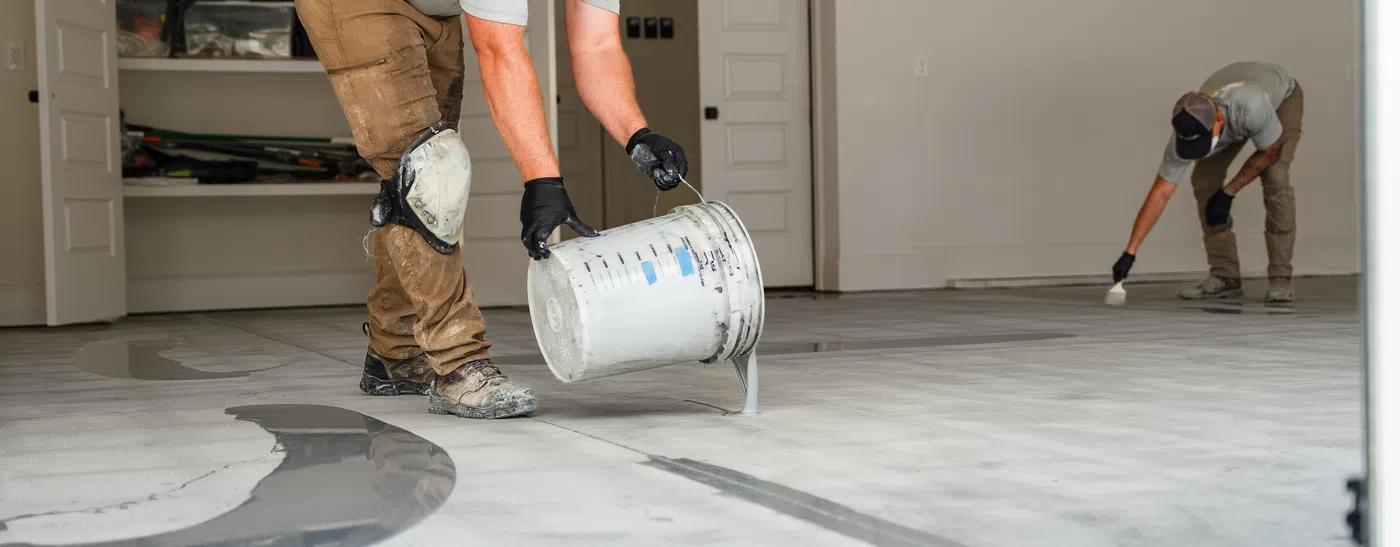
How Epoxy Floor Coatings Adapt to Every Garage Use — And Why It Matters
How floor coatings adapt to every garage use comes down to one thing: the right system, properly installed.
Here's a quick breakdown:
Garage Use |
What the Floor Needs |
Best Solution |
Daily vehicle parking |
Hot-tire resistance, chemical resistance |
100% solids epoxy base + polyaspartic topcoat |
Heavy storage / cabinets |
Point load tolerance, thick film build |
Professional 15 - 20 mil epoxy system |
Slatwall & overhead racks |
Stable anchoring surface, full coverage |
Epoxy applied before storage installation |
Car lifts |
High compressive strength, full cure |
4 - 7 day cure before loading post pads |
Multi-use / family activity |
Slip resistance, easy cleaning, durability |
Decorative flake epoxy with non-slip topcoat |
Your garage floor takes a serious beating. Hot tires roll in from a summer commute. Oil drips from an aging vehicle. Steel cabinet legs concentrate hundreds of pounds onto small contact points. And in Atlanta's humid climate, moisture vapor pushes up through the concrete slab from below.
Most floors aren't built for all of that at once. Bare concrete isn't either.
The good news: our professional system — featuring our hero product, a 100% solids epoxy basecoat, paired with a polyaspartic topcoat working strictly in tandem — handles every one of those demands. Applied during our meticulous two-day installation process, this system delivers the right thickness over properly prepared concrete to support your storage setup and daily activities.
This guide covers exactly how that works, from surface prep to storage integration to long-term care.

Why Epoxy Basecoats with Polyaspartic Topcoats are the Ultimate Heavy-Duty Solution
To understand why our system is so durable, we have to look at the chemistry. A truly heavy-duty garage floor coating cannot rely on a single material to do everything. Instead, it requires an engineered multi-layer system where our primary hero product — 100% solids epoxy — works in tandem with a high-performance topcoat.
The foundation and absolute hero of our system is a professional-grade, 100% solids epoxy basecoat. Unlike watered-down retail products that dry through evaporation (losing up to 50% of their thickness in the process), 100% solids epoxy cures through a chemical reaction. It bonds at a molecular level with the concrete, achieving an adhesion strength of up to 450 psi. This means the concrete itself will actually crack or pull apart before our epoxy basecoat separates from it.
While epoxy provides the ultimate mechanical bond, structural strength, and heavy-load support, we utilize a polyaspartic topcoat strictly as a protective topcoat. It is designed to work in tandem with the epoxy basecoat, not as a standalone or competing product. Polyaspartic coatings are flexible, UV-stable, and chemically resistant, serving as the perfect shield over our hero epoxy layer. By combining these two components in our signature, meticulous two-day installation process, we build a floor that moves with your concrete slab, resists yellowing under intense Southern sunlight, and shrugs off chemical spills.
Here is a direct look at how these two layers work together:
Performance Characteristic |
100% Solids Epoxy Basecoat (The Hero Base) |
Polyaspartic Topcoat (The Protective Shield) |
Primary Role |
Structural adhesion & concrete bonding |
Impact, chemical, & UV protection shield |
Flexibility & Thermal Movement |
Rigid, high compressive strength (withstands heavy loads) |
High elasticity (prevents cracking as concrete shifts) |
UV Stability |
Vulnerable to yellowing if exposed directly to sunlight |
100% UV-stable; will not yellow, fade, or chalk |
Chemical & Abrasion Resistance |
Excellent resistance to oils, greases, and solvents |
Superior resistance to acids, salts, and scratching |
Hot-Tire Pickup Resistance |
Moderate (can soften under extreme tire heat if unprotected) |
Outstanding (immune to hot-tire pickup) |
Application Thickness |
High-build (creates a thick, leveling 10 - 15 mil layer) |
Thin, durable seal (typically 4 - 8 mils) |
Our mandatory two-day installation process is critical to achieving this level of durability, ensuring that each layer is allowed to cure under optimal conditions. On Day 1, our professional crew prepares the concrete and applies the thick, high-build epoxy basecoat, broadcasting a full layer of decorative flakes into the wet epoxy. On Day 2, we return to scrape away any loose flakes and seal the entire system with our high-performance polyaspartic topcoat. This deliberate, two-day schedule ensures a far superior bond and a much thicker film build (typically 15-20 mils total) than rushed "one-day" systems, which often skip critical priming steps and compromise the integrity of the floor.
How Epoxy Floor Coatings Adapt to Every Garage Use with Epoxy Durability
Multi-use garages require a floor that can adapt to a wide variety of activities. One day your garage is a parking space; the next, it is a workshop, a home gym, or a spot for a neighborhood get-together.
To handle this constant transition, the floor must meet heavy-duty performance standards. Our systems are engineered to resist heavy impact from dropped tools and withstand high abrasion. In standard military-grade testing, our topcoats show an abrasion loss of 20 milligrams or less, meaning even rolling heavy toolboxes, dragging floor jacks, and parking heavy SUVs day after day will not wear down the beautiful finish. This level of durability ensures that no matter how you choose to use your garage, the floor remains completely unbothered.
The Science of Adhesion: Why Diamond Grinding Concrete is Critical for Epoxy Success
Ask any professional installer, and they will tell you that proper surface preparation accounts for 90% of a coating's longevity. You could use the most expensive coating material in the world, but if the concrete isn't prepared correctly, the system will peel and fail within months.
That is why we never use acid etching. Instead, we prepare every concrete floor using heavy-duty planetary diamond grinding equipment.
Diamond grinding mechanically removes the weak top layer of the concrete (known as laitance or the "cream" layer) along with any old sealers, paint, or oil stains. This process opens up the pores of the concrete slab and profiles the surface to a texture similar to medium-grit sandpaper (specifically a Concrete Surface Profile or CSP of 2 to 3). This profile creates millions of microscopic anchor points, allowing our 100% solids epoxy to sink deep into the concrete pores and lock in place, forming an unbreakable mechanical bond.
Before we apply a single drop of epoxy, we also perform thorough moisture testing. Moisture vapor transmission (MVT) is the silent killer of garage floor coatings. Concrete is incredibly porous, and moisture from the ground beneath your home constantly pushes upward through the slab. If the moisture vapor pressure is too high (typically above 4.5% on a standard meter or 3 pounds per 1,000 square feet), it will cause standard coatings to bubble, blister, and peel. When we detect high moisture levels, we apply a specialized moisture-mitigating epoxy primer that acts as an impermeable vapor barrier, protecting your floor from hydrostatic pressure for decades.
Preparing Concrete Slabs for Long-Term Epoxy Performance
A critical step in our concrete preparation process is repairing existing damage. Garage floors often develop hairline cracks, pits, and spalls over time due to settling and temperature fluctuations.
Our professional crew opens up every hairline crack using a diamond cutting wheel to remove loose debris and create a clean channel. We then fill these cracks and imperfections with a high-strength polyurea crack filler. Unlike cheap retail patching compounds, polyurea filler cures fast, remains flexible, and can be ground flush with the surrounding concrete. This ensures that the finished epoxy coating is completely seamless, with zero cracks or joints "telegraphing" through to the final surface.
How Epoxy Floor Coatings Adapt to Every Garage Use: Integrating Epoxy with Storage Systems
When planning a total garage transformation, the sequence of your installation is important. To ensure your floor coatings, cabinetry, and wall systems work together flawlessly without creating stress points, the floor coating must always be installed first.
Applying the epoxy floor coating before installing cabinets or wall systems offers several key advantages:
- Complete Protection: The epoxy coating creates a continuous, seamless barrier across the entire concrete slab, protecting the concrete underneath your heavy cabinets from moisture and spills.
- Easier Cabinet Installation: Cabinet installers will have a perfectly level, clean surface to work on, making it easier to align and secure your storage units.
- Flexible Layouts: If you decide to reconfigure your garage layout or swap out your cabinets years down the road, you won't be left with bare, uncoated concrete patches where the cabinets once stood.
By coating the entire floor first, you ensure that heavy point loads are distributed evenly across a fully cured, high-build system. When heavy steel cabinets are filled with tools and gear, they concentrate hundreds of pounds of pressure onto small cabinet legs or toe kicks. Our professional 15-20 mil epoxy systems easily absorb these high point loads without compressing, cracking, or separating from the concrete.
Additionally, we recommend taking the coating's thickness into account when planning overhead storage racks. While our high-build systems only add about 1/8 inch to the overall floor height, keeping this in mind ensures that your overhead rack clearance calculations are accurate down to the millimeter, preventing any surprises when parking tall SUVs or vans.
Coordinating Epoxy Installation with Cabinets and Slatwalls
Once the floor is coated, integrating your storage systems requires a few professional best practices to avoid creating stress points.
When anchoring heavy cabinets or slatwall framing to the walls, installers must drill through the cured coating. Because our polyaspartic topcoat — working strictly in tandem with the epoxy basecoat — is highly flexible, it accommodates this drilling without cracking or chipping around the anchor points.
For the ultimate clean look, we often install color-matched aluminum or PVC baseboards at the junction where the coated floor meets the wall-mounted slatwall. This detail prevents dust, dirt, and moisture from collecting in the seam between the floor and the wall, making your garage easy to clean with a simple sweep or damp mop.
Engineering Epoxy Floors for Extreme Demands: Car Lifts and Hot-Tire Pickup
For automotive enthusiasts and home mechanics, a garage floor has to handle some of the most extreme physical demands imaginable. If you plan to install a post-mounted car lift, your floor coating selection and installation timeline must be carefully planned.
A typical four-post car lift supporting a 4,000-pound vehicle can concentrate over 1,500 pounds of pressure on each individual post pad. This massive load concentration requires a floor with incredible compressive strength. Our hero product, the 100% solids epoxy basecoat, excels under these conditions, distributing the weight across the concrete slab without compressing or cracking.
However, timing is everything. While our polyaspartic topcoat — which works strictly in tandem with the epoxy basecoat — allows for light foot traffic within 24 hours of our professional two-day installation, the entire system requires a full cure period of 4 to 7 days before it can handle heavy point loads like car lift post pads or heavy rolling jacks. Placing these loads on the floor before it has fully cured can cause permanent compression damage.
Additionally, we recommend using drip trays under your vehicles to catch oil, transmission fluid, and brake fluid. While our polyaspartic topcoat is highly resistant to automotive chemicals, keeping the floor clean and wiping up spills promptly ensures that your high-gloss finish remains pristine for decades.
How Epoxy Floor Coatings Adapt to Every Garage Use Involving High-Temperature Tires
One of the most common causes of garage floor failure is "hot tire pickup." This occurs when a vehicle is driven on hot asphalt or highways, heating the tires up to 180°F. When the vehicle parks in the garage, the hot tires transfer that heat directly to the floor coating.
Under cheap retail coatings or standard epoxies, this extreme heat actually softens the coating. As the tires cool down, they contract, grabbing hold of the softened coating and physically pulling it off the concrete when the vehicle drives away.
Our professional systems are specifically engineered to eliminate this issue entirely. By pairing our hero high-build, heat-resistant epoxy basecoat with a durable polyaspartic topcoat working in tandem, we create a floor that withstands tire heat and chemical exposure. The polyaspartic topcoat acts as a protective shield that does not soften under tire temperatures, while the epoxy's unmatched adhesion to the concrete ensures that hot-tire pickup is a thing of the past. This is why we confidently back our floors with a Lifetime Satisfaction Warranty against peeling and hot-tire pickup.
Frequently Asked Questions About Heavy-Duty Epoxy Systems
How long should I wait after epoxy coating to install heavy cabinets?
While our polyaspartic topcoat is dry enough for light foot traffic within 24 hours of our professional two-day installation, you should wait 4 to 7 days before installing heavy cabinets, mounting car lifts, or parking vehicles. This allows the system to reach its full chemical cure and maximum compressive strength, ensuring it can handle heavy point loads without risk of compression or indentation.
Why do standard epoxy floors fail in humid climates like Alabama and Georgia?
In hot, humid southern climates like Atlanta, Alpharetta, and Buford, concrete slabs constantly absorb moisture from the humid air and the damp soil beneath. Standard retail epoxy coatings are sensitive to this moisture. Without proper professional moisture testing and the application of a dedicated moisture-mitigating primer, moisture vapor pressure builds up beneath the coating. This leads to bubbling, blistering, and eventual peeling.
Additionally, standard epoxies lack UV stability, meaning they will quickly yellow and become brittle when exposed to the intense Southern sun. Our system solves this by using our hero product, a moisture-blocking epoxy basecoat, paired with a 100% UV-stable polyaspartic topcoat working strictly in tandem to ensure long-term durability and protection.
What decorative and safety options exist for professional epoxy finishes?
We offer a wide range of customizable decorative finishes to match your home's style and your garage's specific safety needs. Our full-broadcast flake systems mimic the elegant look of natural granite or quartz stone. These flakes are not just decorative; they also add a rich texture to the floor, which naturally increases slip resistance.
For homeowners looking for a sleek, high-end look, we offer mica stone flakes that catch the light beautifully. We can also adjust the gloss levels of our topcoats and add specialized non-slip additives (such as aluminum oxide or glass beads) to ensure excellent wet traction, making your garage floor safer for the entire family even during rainy Georgia afternoons.
Elevate Your Space with a Professional Epoxy System
At Granite Garage Floors, we believe that your garage should be a clean, welcoming, and functional extension of your home. Whether you use your garage for heavy storage, a high-end workshop, daily vehicle parking, or family gatherings, our professional coatings are engineered to adapt to your lifestyle.
Our proprietary two-day installation process centers on our hero product, a 100% solids epoxy basecoat, which provides unmatched bonding power to the concrete, paired with a highly durable, UV-stable polyaspartic topcoat working strictly in tandem to seal and protect the system. The result is a stunning, granite-like finish that is impervious to hot-tire pickup, chemical spills, and heavy loads. We are so confident in our craftsmanship and materials that we back every residential installation with our Lifetime Satisfaction Warranty against peeling and hot-tire pickup.
Don't settle for a dusty, stained concrete floor that limits how you use your space. Schedule a professional consultation with our team in Atlanta, GA today, and let us help you design a garage floor that looks like granite and is guaranteed to last a lifetime!