
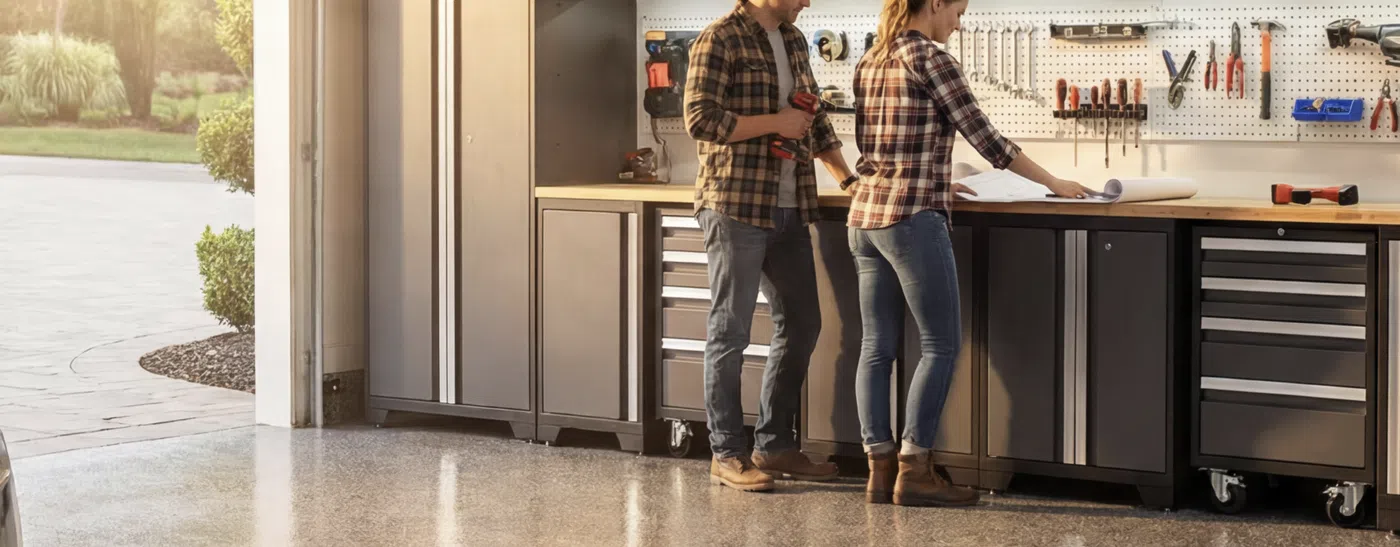
Understanding Professional Garage Floor Epoxy Formulations
When evaluating garage floor epoxy, understanding the underlying chemistry makes all the difference in achieving a showroom finish that endures heavy vehicular traffic. Garage floor epoxy isn't simply paint; it is the primary hero product in professional high-performance systems — a complex thermosetting polymer created by mixing resin and hardener components. When combined, a chemical reaction cross-links the molecules, transforming the liquid into a dense, solid plastic matrix chemically bonded to the porous concrete beneath.
Industrial-grade garage floor epoxy systems create an impenetrable barrier that resists auto fluids, battery acid, road salt, and harsh solvents. More importantly, professional garage floor epoxy offers superior resistance to hot tire pickup — a common failure point where heated tires expand and physically pull weaker coatings off the concrete surface.
Water-Based vs. Industrial 100% Solids Epoxy Coatings
Not all coatings labeled as garage floor epoxy are created equal. The market primarily features low-build water-based or solvent-based formulations and high-build 100% solids garage floor epoxy coatings.
- Water-based epoxy paints: These diluted coatings consist of only 30% to 50% solids by volume. As the water evaporates during drying, the coating shrinks significantly, leaving behind a fragile film measuring roughly 1 to 2 mils thick. Water-based formulas lack the structural density required to withstand heavy vehicles and are vulnerable to blistering and peeling.
- Industrial 100% solids garage floor epoxy: Professional systems utilize 100% solids epoxy basecoats containing zero water or volatile solvents. Whatever thickness is applied wet is the exact thickness that cures solid, producing a thick, self-leveling build between 10 and 20 mils. This heavy build fills fine hairline cracks and creates a deep mechanical bond with the concrete substrate that will not delaminate under heat or load.
Enhancing Epoxy Basecoats with Polyaspartic Topcoats
To achieve ultimate longevity during our efficient two-day installation process, modern high-performance flooring relies on a hybrid system architecture. While a thick 100% solids garage floor epoxy basecoat serves as the hero layer providing unmatched adhesion and structural thickness, finishing the surface with an advanced clear topcoat provides superior surface protection.
Polyaspartic is strictly a protective topcoat engineered to work in tandem with the hero garage floor epoxy basecoat, rather than functioning as a standalone or competing product. More info about residential coating systems highlights how this multi-layer defense provides the ultimate protection. The garage floor epoxy handles the heavy lifting of bonding tightly to concrete, while the polyaspartic topcoat acts as a clear shield providing UV stability, scratch resistance, and rapid curing times. Standard epoxy clear coats can yellow over time when exposed to sunlight near open garage doors; adding a polyaspartic topcoat over the garage floor epoxy ensures your floor remains non-yellowing, glossy, and pristine for decades.
Essential Concrete Preparation for Garage Floor Epoxy Systems
A high-performance garage floor epoxy is only as good as the concrete underneath it. Even the highest-quality garage floor epoxy resin will peel away if applied to an unprepared, contaminated, or smooth slab. Professional installers dedicate the vast majority of their project timeline to mechanical surface preparation, recognizing that preparation accounts for 90% of long-term coating success.
Diamond Grinding Preparation for Garage Floor Epoxy
Chemical etching with acid is an unreliable preparation method that often leaves residual moisture and acid salts inside the slab. The industry standard for long-lasting garage floor epoxy adhesion is heavy mechanical diamond grinding.
Professional crews utilize walk-behind industrial floor grinders equipped with coarse diamond-segmented heads. This equipment removes weak surface concrete (laitance), old paint, tire rubber, and sealers while simultaneously profiling the concrete. The outcome is an open, porous surface texture comparable to 80-grit sandpaper, which allows the garage floor epoxy resin to deeply penetrate the concrete pores and anchor mechanically. Integrated vacuum systems ensure continuous dust collection, protecting the home environment and keeping the slab pristine prior to coating application. Specialized edge sanders are used along borders and walls to guarantee uniform adhesion across every square inch.
Overcoming Concrete Moisture Vapor and Contaminants in Garage Floor Epoxy
Concrete is inherently porous and acts like a sponge, absorbing oils, grease, and atmospheric moisture. Before applying a garage floor epoxy system, technicians perform moisture tests to measure moisture vapor emission rates (MVER). Excessive moisture rising through the slab can create hydrostatic pressure, popping the coating off the surface. When high moisture is detected, specialized moisture-mitigating garage floor epoxy primers are applied to seal the slab.
Oil and grease penetrations require aggressive decontamination:
- Heavy degreasers break down emulsified hydrocarbons on the surface.
- Industrial torches or heat lamps burn away deep-seated oil deposits embedded deep within the concrete matrix.
- Polyurea crack fillers repair static cracks and spalled control joints, creating a seamless, uniform subfloor for the garage floor epoxy installation.
To learn more about how proper mechanical surface preparation promotes adhesion, explore our multi-step preparation process.
Primary Causes of Garage Floor Epoxy Coating Failure
Understanding why floor coatings fail highlights the necessity of professional industrial-grade garage floor epoxy installation techniques.

The primary drivers of garage floor epoxy failure include:
- Inadequate surface profile: Smooth, troweled concrete offers no mechanical keying. Liquid garage floor epoxy applied to smooth surfaces simply sits on top like a film rather than penetrating into the pores.
- Hot tire pickup: When vehicle tires heat up from highway driving, they transfer thermal energy to the garage floor. As the tires cool and contract, they create a suction effect. Poorly bonded, thin paint or low-grade coatings detach from the concrete and pull away clinging to the tire tread.
- Subsurface oil contamination: Residual motor oil prevents garage floor epoxy resins from bonding, leading to localized bubbling and flaking.
- Moisture hydrostatic pressure: Vapor driven upward through saturated concrete slabs pushes against impermeable thin coatings, breaking the mechanical bond.
Performance Factor |
Thin Floor Paint / Low-Build Systems |
Industrial 100% Solids Garage Floor Epoxy System |
Coating build thickness |
1-3 mils (Thins significantly as solvents evaporate) |
10-20+ mils (High-build, 100% solids depth) |
Concrete preparation |
Acid etching or basic washing |
Industrial diamond grinding & vacuum dust extraction |
Hot tire pickup protection |
Low (Prone to lifting and peeling) |
Exceptional (Permanent chemical and mechanical bond) |
UV resistance |
Poor (Yellows and chalks quickly) |
Maximum (When paired with clear polyaspartic topcoat) |
Lifespan |
1-3 years |
Lifetime performance with professional installation |
Decorative Flakes and Anti-Slip Finishes for Garage Floor Epoxy
Beyond structural durability, garage floor epoxy provides immense design versatility. During application, custom color vinyl chips are broadcast into the wet garage floor epoxy basecoat.
A full 100% broadcast density distributes vinyl flakes across the entire floor until the garage floor epoxy base layer is fully saturated. This process creates a thick, multi-layered visual depth mimicking natural granite, quartz, or polished stone finishes. Furthermore, full vinyl chip coverage conceals subtle concrete slab imperfections and minor surface dirt.
Safety is equally crucial in garage environments where wet shoes or rainwater dripping off vehicles can create slipping hazards. Broadcast vinyl chips naturally impart textural relief to the floor. For maximum traction around pools, workshops, or high-traffic bays, micro-materials like aluminum oxide or specialized anti-slip additives (such as Shark-Grip texture) are integrated directly into the clear topcoat over the garage floor epoxy. This provides firm underfoot grip without making the floor difficult to sweep or wash. You can explore finish options to select the perfect aesthetic and texture profile for your home.
Frequently Asked Questions About Garage Floor Epoxy
How long does garage floor epoxy take to cure for foot and vehicle traffic?
Cure times depend on resin chemistry, ambient temperature, and humidity levels. Professional installation teams employ an efficient two-day installation process that minimizes downtime while ensuring maximum coating performance.
- Foot traffic: Light walk-on traffic is generally permitted within 24 hours after topcoat application.
- Vehicle parking: Heavy vehicles and hot tires should remain off the floor for approximately three days (72 hours) to allow the garage floor epoxy and topcoat matrix to reach full shore-hardness and chemical cross-linking.
- Full chemical resistance: Complete curing against aggressive chemicals like brake fluid or battery acid takes roughly five to seven days.
Can garage floor epoxy be applied over an existing floor coating?
Applying a new garage floor epoxy directly over an existing coat of paint or failing sealer is never recommended. If the underlying layer loses bond integrity, the newly applied system will fail along with it. Professional installers use heavy industrial diamond grinding machinery to completely strip away old coatings, paints, and sealers down to sound, bare concrete before installing a fresh garage floor epoxy matrix.
What is the typical cost for professional garage floor epoxy installation?
Professional installation using commercial-grade 100% solids garage floor epoxy with diamond grinding prep typically ranges between $3,000 and $5,000 for a standard residential garage, averaging around $10 per square foot depending on condition, size, and repair needs. While basic floor paints carry lower initial material costs, they frequently peel within months, requiring expensive strip-and-recoat procedures. Investing in professional installation delivers true value backed by long-term durability and structural warranties. For larger industrial or commercial spaces, check out our commercial coating solutions.
Conclusion on Garage Floor Epoxy
Upgrading your garage with a commercial-grade garage floor epoxy system transforms a dusty, stained concrete space into a clean, durable extension of your living environment. Achieving a surface that resists chemical spills, heavy vehicular traffic, and hot tire pickup requires industrial diamond grinding preparation, 100% solids garage floor epoxy basecoats, and UV-stable polyaspartic topcoats.
Our signature two-day installation process ensures your floor receives rigorous mechanical preparation, thick resin application, and proper curing time for ultimate structural integrity. Backed by a Lifetime Satisfaction Warranty against peeling and hot tire pickup, Granite Garage Floors installs finishes that look like granite and stand up to heavy daily use.
Ready to elevate your garage space with top-tier coating technology? Transform your home with Atlanta garage floor experts today and get a free, detailed project estimate!