
Why Your Atlanta Garage Floor Keeps Peeling — And What Actually Stops It
Peeling resistant garage coating options vary widely, but the most durable systems share a few key traits. Here's a quick breakdown of what separates floors that last from floors that fail:
Feature |
What to Look For |
Surface prep |
Diamond grinding to CSP 2-3 profile (not acid etching) |
Coating base |
100% solids epoxy — industrial grade |
Topcoat |
Polyaspartic clear coat for UV and hot tire resistance |
Moisture control |
Calcium chloride testing + vapor mitigation primer |
Installation |
Professional 2-day process for proper cure and bond |
Warranty |
Lifetime coverage against peeling and hot tire pickup |
You spent money on a garage floor coating. You cleared everything out. You waited for it to cure. And for a few months, it looked great.
Then came the first bubble near the garage door. Then a patch lifting under the tire track. Then long strips peeling back like a bad sunburn.
Sound familiar?
This is one of the most common frustrations Atlanta homeowners face — and it happens more than it should. Georgia's heat, humidity, and high water table create some of the toughest conditions for garage floor coatings in the country. A coating that might survive in a drier climate can fail within a season here.
The good news? Peeling is almost never random. It has clear, predictable causes — and clear, proven solutions.
This guide breaks down exactly why garage floor coatings fail, what makes an epoxy system truly bond to concrete for the long haul, and how a professional 2-day installation delivers the kind of stone-finish floor that holds up under heavy use, hot tires, oil spills, and Atlanta summers.

Why Standard Concrete Epoxy Fails: Understanding Moisture and Adhesion
When we look at a garage floor that is flaking or delaminating, the culprit is rarely the liquid in the bucket. Instead, the failure usually happens at the "handshake" between the concrete and the coating.
Concrete is essentially a hard sponge. It is incredibly porous and constantly "breathes" moisture from the ground beneath your home. This process is known as moisture vapor transmission (MVT). In regions like Atlanta, where the water table is high and the soil is heavy clay, this vapor pressure can be immense. If a coating is simply sitting on top of the concrete rather than being bonded into it, hydrostatic pressure builds up. Eventually, that pressure has to go somewhere—and it pushes the coating right off the surface, resulting in those frustrating bubbles and peels.
According to research on why coatings peel and better options, many failures are also linked to the "laitance" layer. This is a weak, milky layer of cement dust that rises to the top when concrete is poured. If you apply epoxy directly to laitance, you aren't bonding to the slab; you're bonding to dust. When the epoxy encounters the weight of a vehicle, it pulls that weak dust layer right off the floor.
To ensure a residential coating system stays put, the concrete must be "opened up" to allow the epoxy to penetrate deeply into the pores.
What is the best method to prepare concrete for epoxy?
If a contractor shows up with a jug of acid and a garden hose, it's time to ask some tough questions. Acid etching is an outdated method that only produces a Concrete Surface Profile (CSP) of 1 or 2. This is roughly the texture of fine sandpaper, which is often insufficient for a permanent bond. Furthermore, acid etching introduces gallons of water into a porous slab—the very thing we want to avoid.
The industry gold standard, and the method we use at Granite Garage Floors, is industrial diamond grinding. Using heavy machinery equipped with diamond-segmented blades, we mechanically remove the laitance layer and any old sealers. This process achieves a CSP 2-3 profile, which feels like 80-grit sandpaper and provides the "teeth" necessary for the epoxy to bite into the concrete.
Our process also utilizes high-efficiency dust containment systems. This means we aren't just making the floor better; we're keeping your garage and your home clean while we do it. Mechanical profiling is the only way to ensure a peeling resistant garage coating that can withstand the test of time.
The Science Behind a peeling resistant garage coating and Epoxy Bond
The chemistry of the coating matters just as much as the preparation. Many off-the-shelf products are water-based or solvent-based, meaning they are only 30% to 50% "solids." As they dry, the water or solvent evaporates, leaving behind a film that is as thin as a sheet of copy paper (about 2-4 mils).
In contrast, a professional system uses 100% solids epoxy. This material doesn't "dry" through evaporation; it "cures" through a chemical cross-linking reaction. What you put down on the floor is what stays on the floor, resulting in a thick, industrial-grade build that is roughly 20 times stronger than standard epoxy paints.
Prep Method |
Concrete Surface Profile (CSP) |
Adhesion Strength |
Reliability |
Acid Etching |
CSP 1-2 |
Low/Surface Only |
Poor |
Diamond Grinding |
CSP 2-3 |
High/Mechanical Bond |
Excellent |
Power Washing |
CSP 0-1 |
Minimal |
Fails quickly |
These industrial-grade polymers are engineered for thermal shock resistance. This is vital in April 2026, as Atlanta's spring temperatures can swing wildly. Your concrete expands and contracts with the weather; your epoxy must be flexible enough to move with it without snapping the bond. For more professional epoxy flooring insights, we look at how these high-solids systems create a permanent, monolithic structure with the slab.
How long does a peeling resistant garage coating epoxy last?
When installed correctly, a high-quality epoxy system isn't a temporary fix; it's a 15- to 20-year investment. Because the epoxy has deep-rooted adhesion within the concrete pores, it becomes part of the floor itself. Unlike thin DIY kits that fail within 12 to 18 months, our industrial-strength systems are designed to handle the weight of heavy SUVs, the dragging of toolboxes, and the constant traffic of a busy household.
Why is moisture testing critical for a peeling resistant garage coating epoxy?
You wouldn't build a house on a swamp without checking the soil, and you shouldn't coat a floor without checking for moisture. Before we ever mix a batch of epoxy, we perform moisture testing.
The most common method is the ASTM F1869 Calcium Chloride test, which measures the rate of moisture vapor emission from the slab. If the levels are too high (typically above 3 lbs per 1,000 sq. ft.), we utilize specialized moisture-mitigating primers. These primers are designed to withstand high hydrostatic pressure and act as a vapor barrier, "locking" the moisture in the concrete so it can't push the epoxy off the surface. Ignoring this step is the number one reason even "professional" floors fail in humid environments.
The 2-Day Installation Process for a High-Performance Epoxy System
Time is a critical ingredient in a peeling resistant garage coating. While some companies promise a "one-day floor," we believe in a meticulous 2-day installation process. Why? Because concrete doesn't like to be rushed.
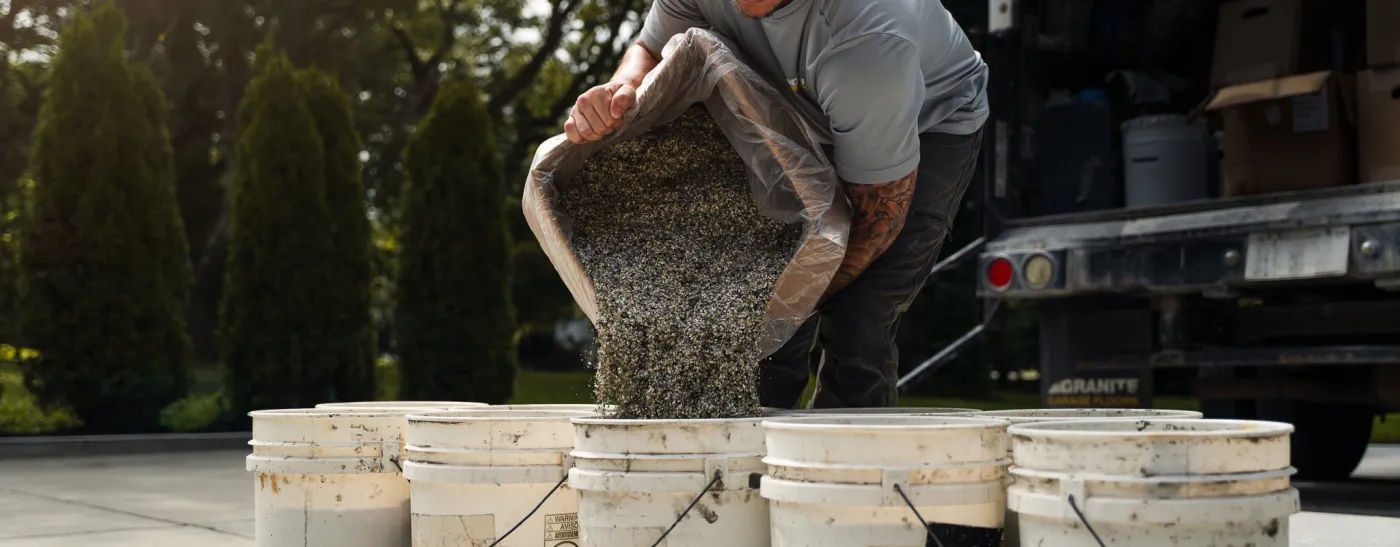
Day 1: Preparation and Base Coat We begin with diamond grinding to ensure the slab is porous and clean. We then spend significant time on repair. We chase out cracks, fill pits, and repair spalled areas using high-strength epoxy fillers. Once the "canvas" is perfect, we apply our 100% solids epoxy base coat. While the epoxy is still wet, we perform a "full broadcast" of decorative flakes. We don't just sprinkle them; we cover every square inch until the floor is saturated. This adds thickness, texture, and incredible durability.
Day 2: Recovery and Topcoat After the base coat has cured overnight, we return to reclaim the excess flakes and "scrape" the floor to ensure a uniform texture. Finally, we apply the polyaspartic topcoat. This two-day schedule allows the epoxy to properly cross-link with the concrete, ensuring the bond is unbreakable before the protective layers are added. For more details, you can view more info about our process.
Achieving a granite-like epoxy finish
One of the most exciting parts of our system is the aesthetic. By using a dense broadcast of multi-colored flakes, we create a finish that mimics the look of natural granite, quartz, or stone. This isn't just for looks—the flake layer actually acts as a "shingle" system, providing extra impact resistance and hiding minor imperfections in the concrete. Whether you want a modern "Stonehenge" gray or a warm "Shoreline" tan, the result is a seamless, showroom-quality surface that adds significant value to your home.
Why Polyaspartic Topcoats are Essential for Peeling Resistant Epoxy Floors
If epoxy is the "muscle" of the floor, the polyaspartic topcoat is the "armor." While epoxy is an incredible adhesive, it has two main weaknesses: it can yellow when exposed to UV light (sunlight through garage windows), and it can soften under the heat of car tires.
This is where polyaspartic technology comes in. As a high-performance topcoat, polyaspartic is:
- UV Stable: It will never yellow or "chalk," even if your garage door stays open all day.
- Hot Tire Resistant: It resists "hot tire pickup," a phenomenon where hot tires bond to inferior coatings and rip them off the floor as you pull out of the driveway.
- Chemical Shielded: It is impervious to road salt, gasoline, motor oil, and even battery acid.
For businesses and heavy-use residential spaces, these commercial-grade finishes provide the abrasion resistance needed to keep the floor looking new for decades.
Maintaining your epoxy stone finish
Keeping your new floor pristine is surprisingly easy. Because the surface is seamless and non-porous, dirt and fluids stay on top rather than soaking in.
- Routine Cleaning: A simple sweep with a soft-bristle broom or a leaf blower handles most dust.
- Deep Cleaning: Once a month, mop the floor with a mixture of warm water and a pH-balanced cleaner (like Simple Green or ammonia).
- Avoid Wax: You never need to wax or buff a polyaspartic topcoat; its high-gloss luster is permanent.
Conclusion: Investing in a Lifetime Epoxy Solution
A garage floor is more than just a place to park your car; it's the primary entrance to your home. Don't settle for a coating that will look like a "sunburned" mess in twelve months. By choosing a system that combines industrial diamond grinding, 100% solids epoxy, and a polyaspartic topcoat, you are choosing a floor that is truly peeling resistant.
At Granite Garage Floors Atlanta, we back our work with a Lifetime Satisfaction Warranty against peeling and hot tire pickup. We serve homeowners across the Atlanta metro area—from Alpharetta and Marietta to Buckhead and Vinings—as well as our many locations nationwide. We take pride in our two-day process because we know it's the only way to guarantee a floor that looks like stone and acts like armor.
Ready to transform your garage? Schedule your free assessment at Granite Garage Floors Atlanta today and see the difference that a professional-grade epoxy system can make.